
Um Kadada, North Darfur
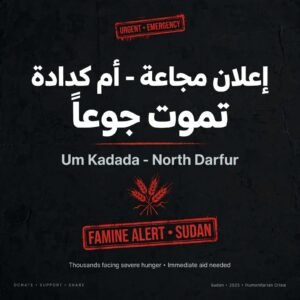
The Council of Emergency Rooms of Um Kadada locality in North Darfur State has declared a full-blown famine in an urgent appeal No. (01) issued on October 5, 2026, warning that a quarter of a million people are at imminent risk of starvation
.In a statement based on reports from 25 sub-emergency rooms on the ground, the council said the situation is now catastrophic: a complete lack of food and medicine, acute shortage of safe drinking water, total collapse of purchasing power due to extreme poverty and loss of income sources, and an almost complete absence of international humanitarian organizations from the field.
The statement said: “The communal kitchens run by the emergency rooms – which were intended only for the displaced – have become the only lifeline for most residents, and they are about to stop. What we receive covers less than 5% of the need. The window to prevent death from starvation is measured in days.. We expect mass deaths among children, pregnant women and the elderly within days if immediate intervention does not occur.”Um Kadada is located southeast of El Fasher, capital of North Darfur, covering an estimated area of 23,076 square kilometers. Its total population is about 244,531 people, including 81,822 internally displaced persons (IDPs), 1,817 returnees, and host communities. Among them are 146,720 women, 61,133 children, 4,054 persons with disabilities, and 8,559 elderly.According to the field assessment, more than 84% of the population struggles to obtain sufficient food. Families have reduced the number of meals, are increasingly relying on poor-quality food, and have started selling productive assets to survive.
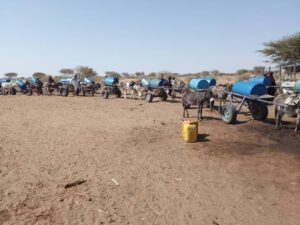
Cases of acute malnutrition among children and pregnant women are rising, along with malaria, fever, diarrhea and typhoid, worsened by unsafe water.Water access is critical. People rely on deep wells (800-1200 feet) and shallow wells (60-120 feet). The price of a water barrel has risen from 5,000 to 15,000 Sudanese pounds, and it takes 3-4 hours to collect 38 liters, a task often done by girls.Only 1 hospital and 18 health centers out of 26 are functioning. Schools are closed.The Council urgently demands:
1- Declare Um Kadada a famine zone and open a safe humanitarian corridor immediately.
2- Urgent delivery of food and therapeutic food RUTF.
3- Direct emergency funding for communal kitchens via on-the-ground emergency rooms.
4- Joint field assessment by OCHA, WFP, UNICEF and WHO within 48 hours.Contact: info@eccul-sudan.org | +821083350899 | +447715564696
The population includes approximately: 146,720 females 61,133 children 4,054 persons with disabilities 8,559 older people The population is distributed across larger villages, smaller settlements, and IDP camps. 3. Why Is Um Kadada Considered a Famine-Affected Area? The conflict that erupted in Sudan on 15 April 2023 has had a significant impact on North Darfur State as a whole and on Um Kadada Locality in particular. The prolonged conflict has severely disrupted people’s ability to pursue their normal livelihood activities and access essential sources of income, particularly agriculture, livestock production, and trade. Approximately 90 per cent of the population is reportedly dependent on these activities for their livelihoods. The conflict has also contributed to tribal tensions, mass displacement, and the erosion of social cohesion and community structures. A significant proportion of the locality’s young population, particularly males, have been displaced in search of safety. Some have relocated to other parts of Sudan, while others have sought refuge in neighbouring countries. Others have joined the parties to the conflict, while some have turned to artisanal mining as an alternative source of income.
The immediate consequences include the loss of productive labour, rising prices of essential commodities, looting, and road blockages, all of which have further constrained access to food and livelihoods. The presence of IDPs and the sharing of already limited resources and basic services with host communities have placed additional pressure on scarce resources and overstretched services. 3.1. Drought and El Niño Average rainfall over the past two years has remained below normal
levels, adversely affecting agricultural seasons and reducing agricultural productivity. At the same time, sharp increases in fuel prices and the cost of agricultural inputs have placed an additional burden on households. The resulting decline in agricultural production, compounded by labour shortages, has further eroded livelihoods and contributed to child labour.
As a result, some children have been compelled to leave school in order to support their families’ basic survival needs. The poor quality and limited availability of seeds, pesticides, and fertilizers have further constrained agricultural production.
4. Current Rainy Season The rainy season in the area normally begins in June and continues until the beginning of October. However, indicators for the current season remain concerning, owing to insufficient rainfall, crop failure and drying, and a reduction in cultivated areas, particularly small household farming plots locally known as Jibraka.
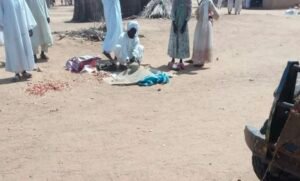 5. Current Humanitarian Situation in Um Kadada Locality More than 84 per cent of the population is experiencing difficulties in obtaining sufficient food. Many households have already reduced the number of meals they consume in an effort to cope with the deteriorating food situation. Among both host-community members and IDPs, the majority are increasingly relying on poor-quality food. Many households have reduced both the quantity and quality of their usual food consumption in an effort to reduce expenditure. Following the depletion of household food stocks, many families have begun selling productive assets in order to obtain food, further undermining their ability to recover and sustain their livelihoods. Attendance at nutrition centres has also increased, alongside reported cases of acute malnutrition among children and pregnant and breastfeeding women. Deaths reportedly associated with hunger and related illnesses have also been reported. In some cases, children discharged from nutrition centres have experienced a deterioration in their health after returning home, reportedly due to inadequate access to food. The main diseases affecting older people and children include malaria, fever, diarrhoea, typhoid, and other communicable diseases. These health conditions are reportedly exacerbated by inadequate access to sufficient and nutritious food and the consumption of unsafe water. Some markets have also been affected, with certain markets closing or operating at reduced capacity, thereby limiting the availability and accessibility of essential goods and services.
6. Community Needs and Priorities The main needs and priorities identified by the community are: Food assistance Cash assistance to enable households to purchase food Water Health services Education Protection
7. Service Centres and Key Actors Infrastructure and service centres have been severely affected by the conflict, resulting in the destruction, damage, looting, and abandonment of some facilities. Hospitals, health centres, schools, and water sources have all been affected. Some facilities have become completely non-functional, while others are operating at reduced capacity owing to shortages of human resources, limited funding, inadequate training, and insufficient incentives and salaries.
8. Water Sources and Access to Water People in the area obtain drinking water primarily from deep wells, ranging from approximately 800 to 1,200 feet in depth, as well as shallow wells with depths of approximately 60 to 120 feet. Some water sources have been damaged or otherwise affected as a result of displacement and other impacts of the conflict. Access to water has become increasingly difficult due to the high cost of fuel and spare parts. In some areas of Um Kadada Locality, the price of a barrel of water has increased from approximately 5,000 SDG to 15,000 SDG. In some villages, people spend several hours collecting water. Obtaining approximately 38 litres of water (two jerrycans) may take between three and four hours. Given the high levels of poverty, water collection and transportation frequently depend on children, particularly girls, who are often responsible for fetching and carrying water.
9. Environmental Health and Sanitation There is a significant shortage of latrines in IDP camps and some villages. Open defecation remains common, including in open areas and near waste disposal sites. Poor waste management and widespread open defecation have increased environmental and public-health risks and contributed to the proliferation of disease vectors. This situation is largely attributable to poverty, limited household resources to purchase essential sanitation materials, and the prioritisation of food security and livelihood needs.
10. Access to Hospitals and Health Centres There is one hospital and 26 health centres in the locality, of which 18 are currently operational, while the remaining facilities are out of service for the reasons outlined above. Existing health services are insufficient to meet the needs of the population due to limited resources, long distances, poverty, the high cost of medicines, and transportation constraints. The assessment recommends consideration of mobile clinics to improve access to essential healthcare services. Women of reproductive age face significant barriers to accessing healthcare services, including difficulties in accessing skilled and facility-based childbirth services.
11. Education Education in the locality has been severely affected by the disruption and deterioration of the education system. Many schools have closed, resulting in significant setbacks to children’s education. Children and their families are increasingly engaged in activities aimed at securing food and income, including working in markets, undertaking agricultural activities, and collecting water. The main challenges facing the education sector include shortages of teachers and technical personnel, inadequate teaching and learning materials and textbooks, and insufficient salaries, incentives, and training for volunteer teachers.
12. Key Actors Several actors are providing humanitarian and basic services in Um Kadada Locality, including: Sudanese Red Crescent Emergency Response Rooms National organisations Donors Ministry of Health, particularly through therapeutic nutrition and immunisation services However, the services currently available remain insufficient in relation to the size of the population, the scale of humanitarian needs, and the severity of the deteriorating food-security and nutrition situation. Access to services is also constrained by the limited number of functioning facilities and the considerable distances between some service centres and beneficiaries’ places of residence.
13. Access to Um Kadada Locality Um Kadada Locality in North Darfur State can be accessed through several routes: From the south: via the Na’am Road From the east: via the Dabba Road From the west: via the Adré border road 14.
 Definitions of Local Terms 14.1. Jibraka A small agricultural plot located near a residential area and commonly cultivated by older members of the community. 14.2. Donkey / Donik A local term referring to an artesian borehole operated using a generator, solar energy, or fuel-powered pumping equipment. 14.3. Kosha A local term referring to a designated area where waste is collected. 14.4. Village Council (Majlis Qarya) A relatively large village that provides some basic services, such as a market, water source, school, and other essential facilities.
ظهرت المقالة Um Kadada, North Darfur Declared Famine Zone – 84% of Population Without Food, Emergency Appeal Issued أولاً على السودانية نيوز.